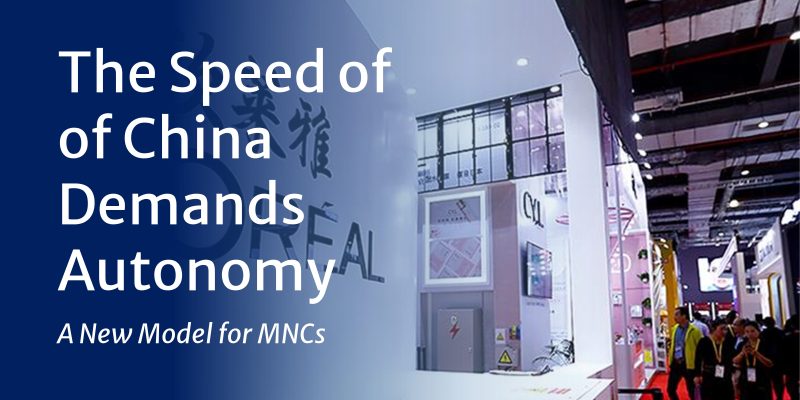
If your China strategy still involves shipping slightly tweaked global products to Shanghai, you’re not just late to the party—you’re in the wrong city. The most critical insight from 2025 isn’t a new consumer trend or a regulatory shift; it’s an organizational one. We’ve witnessed the definitive leap from “China-for-China” (localization) to “China-for-China 2.0”: Localized Innovation Cycles.
This isn’t about translating packaging or adding a WeChat login. It’s about granting your China team the mandate, resources, and—most importantly—the autonomy to conceive, develop, and launch products at the blistering speed of the local market. The global HQ role is evolving from controller to venture capitalist, funding a fast-moving, sovereign R&D outpost.
The Evidence: Autonomy in Action
Companies that embraced this model in 2024-2025 pulled decisively ahead. Let’s look at the data:
- L’Oréal: Their “North Asian Beauty Campus” in Shanghai, fully operational by 2025, is the archetype. It’s not a lab for adaptation; it’s a creation engine. Here, Chinese researchers lead on ingredients like ginseng and tremella, leveraging local consumer insights and biotech partnerships. A flagship result is the Shu Uemura “Yubi” essence, a product conceived and developed entirely in China for Asian skin concerns, now becoming a global hero product. The direction is clear: from “Made in China” to “Created in China for the World.”
- Nestlé: Their “China Innovation Center” in Shenzhen operates with remarkable independence. In 2024, they launched a slew of products under local brands like “Yinlu” and “Shark Fit” that you won’t find elsewhere: seaweed-flavored peanut milk, zero-sugar ready-to-drink oats tailored for Chinese breakfast habits, and probiotic shots for gut health. The direction: acting as a local food & beverage champion, not just a branch of a Swiss conglomerate.
- Starbucks (via its partnership with Mengniu): The “Starbucks Ready-to-Drink (RTD)” business in China, produced with Mengniu, functions as its own entity. In 2025, they accelerated launches like the “Coffee Soda” series and “Oatmeal Latte”—products developed specifically for Chinese convenience store channels and taste profiles, on a timeline unimaginable on a global product roadmap. The direction: Building a parallel, agile business unit for a specific channel (RTD), free from core store operational legacy.
The Anatomy of a Localized Innovation Cycle
What does this look like in practice?
- Insight to Brief in Weeks, Not Months: Teams use real-time data from Douyin, Xiaohongshu, and Taobao reviews to spot emerging needs.
- R&D with Local “Know-How”: Partnerships with local universities, TCM institutes, and material science startups are leveraged, not just global suppliers.
- Prototype & Validate at China Speed: Fast iterations with consumer panels and live commerce testing on Douyin allow for rapid refinement.
- Launch and Scale in 6-9 Months: The entire cycle from idea to nationwide shelf is compressed to a fraction of the global 18-24 month standard.
The Personal Stake: It’s About Letting Go
Here’s the uncomfortable truth for global HQ: this model requires letting go. It means accepting that your team in Shanghai might reject a global “hero” product because the insight is two years old. It means funding a project based on a cultural nuance you don’t fully grasp. It means your most exciting new product in 2026 might come from a brief you never approved.
The direction for 2026 is unambiguous. The question isn’t whether you can afford to build this autonomous capability. It’s whether you can afford not to. In China, speed is no longer just a competitive advantage—it’s the only currency that matters. Are you structured to spend it?