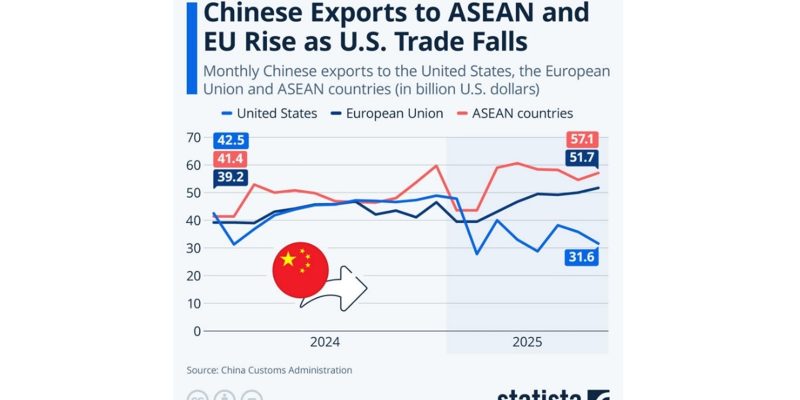
The 2025 trade data from China’s General Administration of Customs contains a quiet but significant shift. While the United States remained China’s largest single trading partner at $560 billion, bilateral trade fell 18.7%—the steepest decline among major partners. Meanwhile, a collective realignment toward Southeast Asia is becoming unmistakable.
Consider this: in the first ten months of 2025, China’s combined exports to Vietnam, Malaysia, Thailand, and the Philippines exceeded those to the United States. Vietnam alone grew its trade with China by 13.7%, reaching $296 billion. Indonesia followed closely at 13.4% growth, and Thailand at 14.4%. These are not peripheral adjustments. They suggest a fundamental re-anchoring of regional supply chains, with China remaining the central node but the flow patterns visibly diversifying.
For multinational executives, the implication is subtle yet practical. The old assumption that “China equals the China market” may need updating. What is emerging is a more integrated regional ecosystem—where components move from China to ASEAN for final assembly, and where finished goods flow to global markets or back into China. Being present in China alone may no longer suffice. Understanding how trade corridors now link Shenzhen to Ho Chi Minh City, or Shanghai to Jakarta, could become as important as understanding Beijing’s policy direction.
The data does not declare a winner or loser. It simply shows that gravity is shifting. For those planning to enter or expand, the real opportunity may lie not in choosing between China and Southeast Asia, but in building strategies that move with the region’s new center of gravity.